Programmer for ALTERA FPGAs — JTAG & Active Serial, with adjustable termination and an integrated logic analyser
Adjustable programming frequency, adjustable termination, integrated logic analyser: your ALTERA FPGAs program reliably — from the short lab cable to the long line on the test floor.
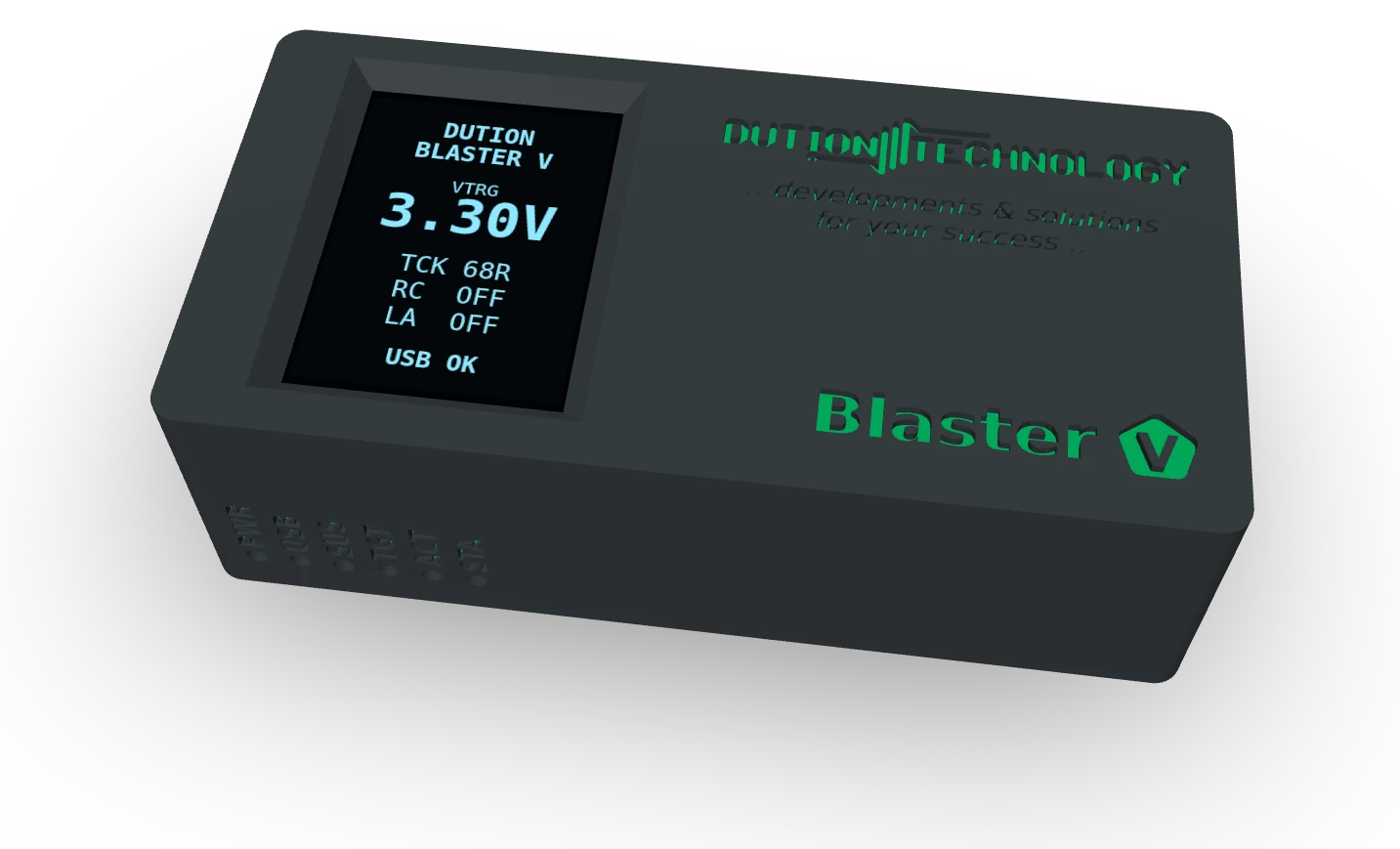
The Dution-Blaster V connects your PC to ALTERA FPGAs, CPLDs and configuration flashes over USB 2.0 Hi-Speed. You set programming frequency and termination to suit your setup — so programming works even where other adapters give up.
Drag to rotate, scroll to zoom, right-drag to pan.
Program, listen in, display, adapt — all over one USB cable.
Programs ALTERA FPGAs, CPLDs and configuration flashes — with adjustable programming frequency, automatically matched to your target voltage.
Listens in on every signal at the header without loading the target, so you see at once what happens on the line.
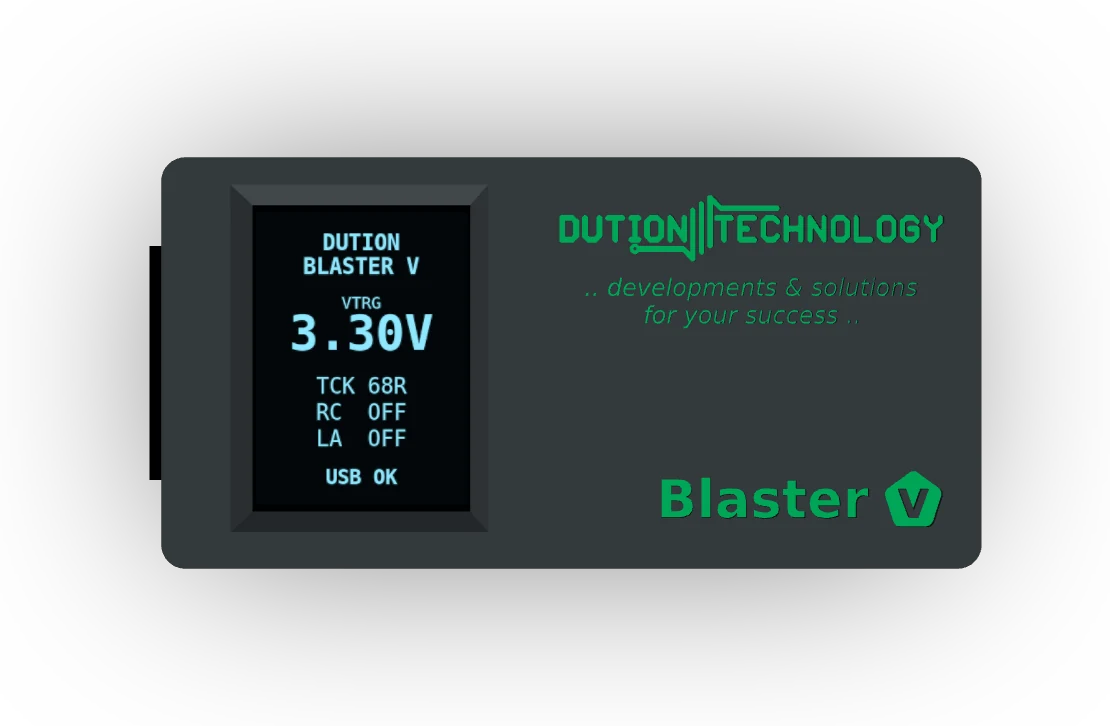
A plug-in 0.96″ display shows target voltage, termination and status — at a glance, without software.
Matches the line to your cable under software control. Without software the adapter starts with safe defaults.
Long ribbon cables and fast edges are the most common cause of unreliable JTAG. The Dution-Blaster V matches the TCK series resistance to the line instead of using one fixed value.
Four resistors can be enabled individually or in parallel. The 68 Ω default suits typical ribbon cables. Together with the adjustable programming frequency you program reliably even over long lines.
Pick resistors and functions — the calculator shows the resulting series resistance.
| USB | USB 2.0 Hi-Speed (480 Mbit/s), bus powered |
|---|---|
| Protocols | JTAG (IEEE 1149.1), Active Serial for configuration flashes |
| Programming frequency | adjustable, up to 15 MHz |
| Target voltage | 1.2–3.6 V, automatic via target VCC (header pin 4) |
| Protection | Overcurrent protection for USB supply and target voltage |
| TCK termination | 33 / 47 / 68 / 100 Ω, individually and in parallel, default 68 Ω |
| TDO termination | RC network 100 Ω + 100 pF, switchable |
| Logic analyser | integrated, listens in on TCK, TDI, TDO, TMS, nCE, nCS and DATAOUT |
| Display | OLED 0.96″, 128 × 64, pluggable |
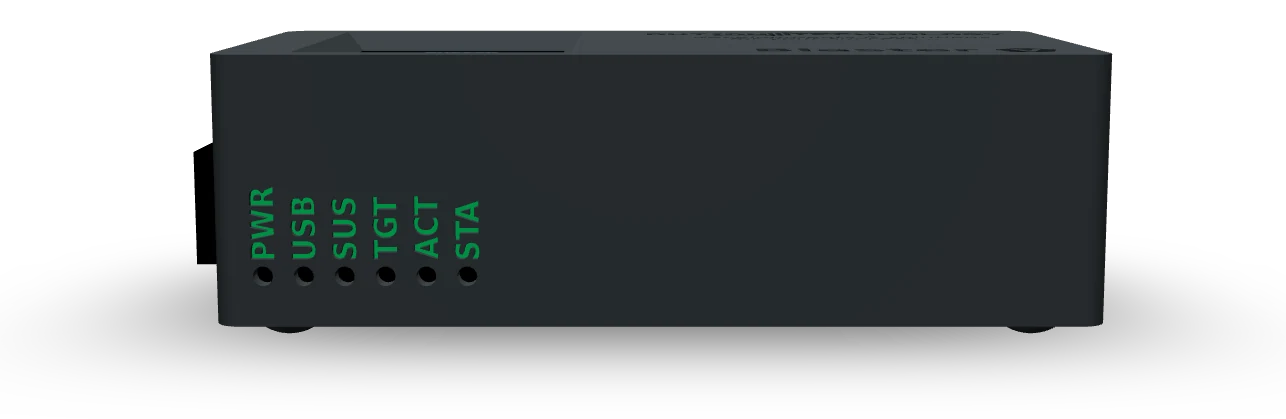
| Status LEDs | 6: 3.3 V, USB configured, USB suspend, target powered, JTAG clock, activity |
| Target header | 10-pin, 2.54 mm, right angle, Altera-compatible pinout |
| Dimensions | housing approx. 70 × 35 × 25 mm |
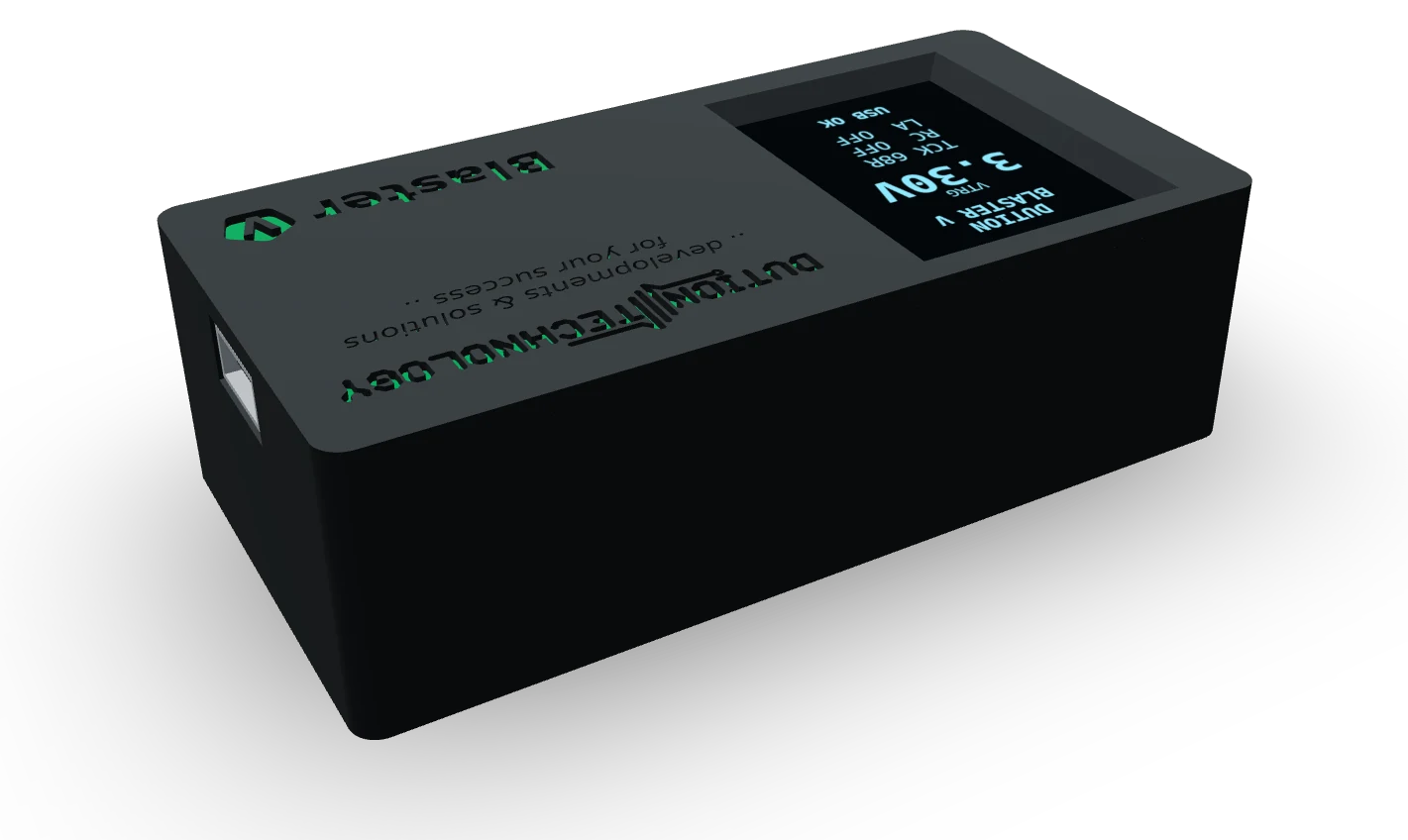
A handy housing of about 70 × 35 mm: the easy-to-read display on top, six status LEDs at the front, the Altera-compatible 10-pin header on one side and USB on the other. The ribbon cable leaves freely.
The pinout follows the widely used Altera 10-pin standard for JTAG and Active Serial.
All ALTERA FPGAs and CPLDs that are programmed via JTAG on the common Altera 10-pin header — for example MAX 10, MAX II/V, Cyclone, Arria and Stratix. Via Active Serial it also programs serial configuration flashes such as EPCS and EPCQ.
The most common causes are a TCK clock that is too fast for the cable length, overshoot on TCK with long ribbon cables, a missing or wrong target voltage on pin 4 and a poor ground connection. With the Dution-Blaster V you lower the programming frequency, adjust the TCK termination, see the target voltage right on the display and capture the JTAG signals with the built-in logic analyser.
The longer the cable and the more devices in the JTAG chain, the lower the TCK clock should be. The Dution-Blaster V is adjustable up to 15 MHz: fast on the short lab cable, slow and safe over long lines on the test floor. Quintus Programmer suggests a suitable clock at a keystroke.
That depends on clock, cable and board. With a reduced TCK clock and matching termination we programmed and verified a JTAG chain of two ALTERA FPGAs over 2 m of cable — without a single mismatch.
A series resistor on TCK damps reflections on the line. Without proper damping, long ribbon cables cause overshoot that the device sees as an extra clock edge — and the JTAG chain breaks. On the Dution-Blaster V you choose 33, 47, 68 or 100 Ω, individually or in parallel, to match your cable.
1.2 to 3.6 V. The adapter adapts automatically to the voltage on header pin 4 (target VCC) — for 1.2, 1.5, 1.8, 2.5 and 3.3 V I/O banks.
Best with our Quintus Programmer on Windows 11 and Linux. It also works with common open-source tools such as OpenOCD.
Via a quote request: tell us the quantity, target board and cable length — you receive a quote by e-mail. We supply businesses, self-employed professionals and institutions.
The Dution-Blaster V also works with common open-source tools such as OpenOCD.
Without software the adapter starts with TCK 68 Ω, no RC and the logic analyser switched off.
Our programming software for all Altera families: choose the programming frequency, program, verify — learn more →
Trademark notice. Altera and USB-Blaster are trademarks or registered trademarks of their respective owners. All other product and company names mentioned are the property of their respective owners. These names are used solely to describe the header pinout and the components used. Dution-Technology and the Dution-Blaster V are not affiliated with these trademark owners; there is no partnership, authorisation or endorsement.
Tell us the quantity, target board and cable length — you receive a quote by e-mail. The inquiry is non-binding.
Tell us about your target board and cable length — you'll receive a quote by e-mail.